
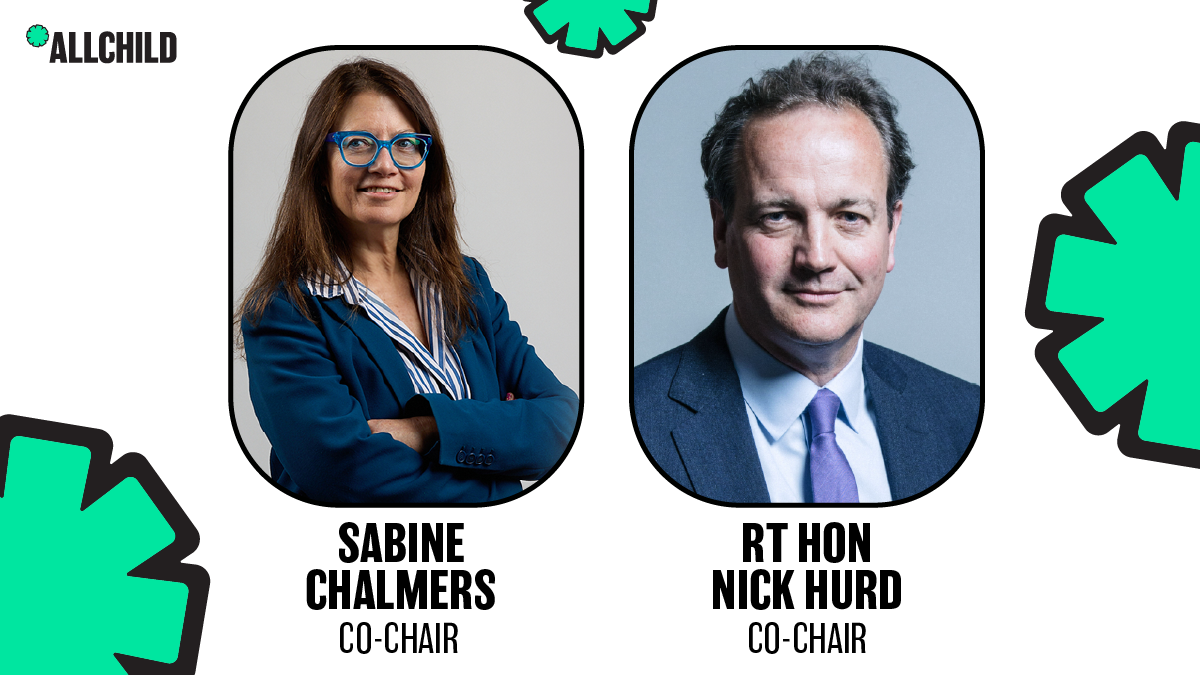
AllChild welcomes Sabine Chalmers and Nick Hurd as new Co-Chairs
Read more


Alan Milburn is right to say that a lost generation is not a fact of life, it is a choice. Because the truth is, it has been a choice, through years of under-investment in children and young people that have created the current conditions in which they are growing up in our communities.
While there’s lots to be encouraged by in the long-awaited report, truly shifting the dial and resetting the system of support surrounding children will only work if we accept that there are some children who will need the system to work completely differently for them in their context. That means turning it on its head, placing them at the centre and building a local ecosystem of support and opportunities around them in their communities.
For years, reforms have let some children down. The real test of Milburn’s proposals is whether they will reach the fifth or so of children and young people who continually fall under the radar and through the gaps, the ones in the communities most struggling with child poverty and where trust in services has been eroded, the ones that those of us who work with children are most worried about. We cannot let that happen again.
That’s why the report’s focus on identifying children at risk much earlier matters so much. Earlier identification is not the responsibility of schools alone. We know from our decade of working deep in some of our communities with the greatest challenges that effective early identification is a collective effort, bringing schools, families and community partners together to recognise risk early and act on it.
Acting on it for those children most in need means a trusted adult who stays with them and their family for the long term. The new Youth Opportunity Service’s named adviser could be that person. But only if the role sees the whole child, and mobilises the system around them and their family, in all the aspects of their life that impact their ability to enter the workforce.
Young people must lead the change. If the trust is there, if they believe in the people around them and vice versa, our experience tells us they can and will shape their own plan. The Youth Opportunity Service must work with them, not be done to them, as that’s how trust will be rebuilt.
We’re encouraged to see outcomes put front and centre with the Better Futures Fund, and its long-term, collaborative funding approach named as a lever for achieving this. It’s how our local Social Outcomes Partnerships already work, with funding tied to positive changes in children’s lives, not just participation in activities or programmes.
Incentives for business to employ young people will be a key enabler. It’s also about employers intentionally making an earlier investment in their future workforce and in the communities they operate. Many of our partners already do this, working together alongside children to combine investment with support and opportunities to build their aspirations.
The report’s own youth opportunity test should apply to its welfare proposals too. As that detail is worked through, no child or young person in a family already struggling to make ends meet should find life getting harder as a result.
This is a generation that cannot wait, and we owe it to them to get this right. AllChild will continue to focus on the early identification of children who will most benefit, working with councils, schools, families and all the local people who care about children growing up well, to keep building the support and opportunities that help every child flourish socially, emotionally and academically in their community.
Louisa Mitchell
Chief Executive AllChild
Read Alan Milburn’s review, From a Welfare State to a Working State: a new settlement for the next generation.

